Authors
News Type
News
Date
Paragraphs

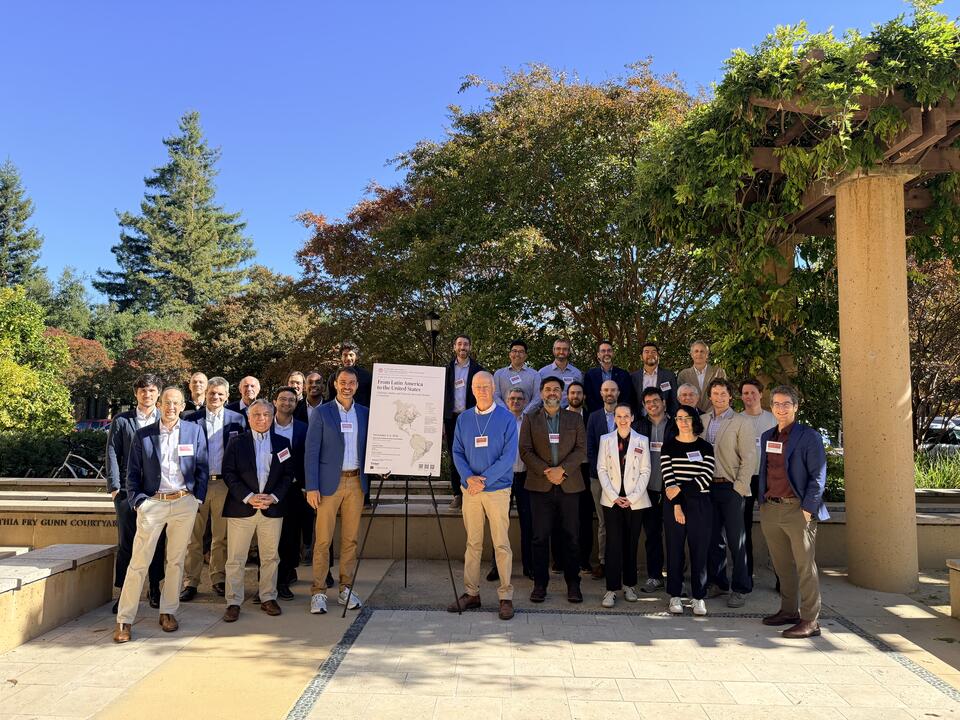
On November 5 and 6, PESD and the Stanford Center for Latin American Studies co-hosted the conference "From Latin America to the United States: Challenges, Models, and Policies for Electricity Markets in Transition" with support from the Tinker Foundation. 

From the conference agenda:

"The rapid integration of intermittent renewables worldwide has raised significant concerns about long-term supply adequacy in markets increasingly dominated by zero-marginal-cost resources. Hydro-dominated Latin American countries, in contrast, have been addressing this challenge for more than two decades by developing long-term instruments and innovative market designs. However, only after 2020 did these countries begin to experience the large-scale deployment of solar and wind generation, facing problems that the United States and Europe have largely addressed through more accurate, operationally aligned short-term price signals and long-term capacity mechanisms that enhance flexibility and ensure long-run supply adequacy. Drawing on the best practices and lessons from both hemispheres, this workshop explores the interplay between short-term market signals and long-term instruments in renewable-dominated, low marginal-cost electricity markets to address the common challenges of the future. Speakers may cover any relevant topic within the wide range of current challenges faced by these markets.

 Our goal is to bring together the experience and points of view of system operators and academics on what is crucial to address in terms of market design and what would contribute most to current discussions."
 

Image
Group photo from PESD CLAS workshop
All News button
1
Date Label
Display Hero Image Wide (1320px)
No

616 Jane Stanford Way
Encina Hall East
Stanford, CA 94305

(415) 745-2636
0
Research Affiliate at PESD
IMG_0795.JPG JD

Ognen Stojanovski has been affiliated with PESD since 2005 (while still a student at Stanford Law School) and returned to the program in 2012. He is charged with leading PESD’s research platform on low-income energy services, which studies the kinds of economic and institutional arrangements that can deliver modern energy services to the poor at scale and in a durable way (as opposed to whether a specific technology can be made to work on a one-off basis).

His current research focuses on measuring and quantifying the economic and social welfare impacts of solar PV products in developing countries, as well as identifying innovations in the off-grid solar industry that can improve business performance and maximize end-user benefits. He is also keenly interested in investigating the theory and practice of impact investing in social enterprises intended to both promote development and deliver financial returns. Stojanovski was previously part of PESD's research on national oil companies and authored the chapter on Pemex and the Mexican oil sector in the book Oil and Governance: State-owned Enterprises and the World Energy Supply.

Stojanovski has designed and carried out multiple randomized controlled trials (RCTs) and other field research projects in challenging environments. He has also been responsible for developing and maintaining relationships with both commercial and research partners that have enabled PESD to perform effective research in these settings. He authored successful research grant proposals to support this work.

Stojanovski developed the curriculum for Economics 121: “Social Science Field Research Methods,” a new course he has co-taught (along with Frank Wolak and Mark Thurber) since 2015. The course aims to equip students with strong foundations in research design and rigorous data analysis, along with the practical skills required for successful fieldwork implementation and project management. In the summer of 2015, he organized and led a group of selected students from the course to conduct an RCT in Puebla, Mexico. They explored how households use electricity and tested whether information about electricity pricing and conservation leads to changes in behavior.

Stojanovski’s research at the nexus of energy and development is motivated and informed by working, living, and traveling through over 20 developing countries in sub-Saharan Africa, central and eastern Europe, and South America for four years (October 2007-October 2011).

Additionally, Stojanovski has extensive experience in the autonomous vehicles industry, starting as a competitor in the first DARPA Grand Challenge while in graduate school in 2003-04. Most recently, he helped launch Otto (a startup later acquired by Uber) where he spearheaded policy, internal research, and external advocacy efforts. He developed the company’s policy position and compiled research probing the potential safety, fuel-efficiency, greenhouse gas emissions, and productivity benefits of self-driving commercial motor vehicles. He also organized and led a team undertaking a detailed econometric analysis on the possible impacts of this technology on the trucking labor market (available here).

Stojanovski has worked closely with policymakers, regulators and law enforcement at the federal, state, and international levels to develop and implement autonomous vehicle policies. He cleared a regulatory path forward for major milestones, including: (1) the first-ever commercial delivery by an autonomous truck ; (2) the first series of interstate shipments by (SAE level 2) self-driving trucks; and (3) the first framework for the development and testing of self-driving trucks in California. Stojanovski continues to actively advise on policy and legal issues related to autonomous vehicles.

Stojanovski has a background is in law and engineering. He received his J.D. from Stanford (with distinction) and also holds masters and bachelor’s degrees from UC Berkeley in Industrial Engineering and Operations Research (with highest honors). He is an active member of the State Bar of California and has advised clients on a wide range of corporate legal issues.


Authors
News Type
News
Date
Paragraphs

With the advent of the "shale gas revolution," the United States has undergone a full-scale natural gas boom. Driven by fracking and horizontal drilling, the United States will likely overtake Russia as the world's largest producer of natural gas by 2015, according to the International Energy Agency.

Now, as estimates of available reserves continue to go up and prices drop to less than $3 per million BTU, talk is turning to exporting natural gas – potentially a serious moneymaker, with countries like Singapore facing per million BTU prices around $16.

As a Stanford economics professor and director of the Program on Energy and Sustainable Development at the university's Freeman Spogli Institute for International Studies, Frank Wolak understands the urge to export.

"But there's a significant risk here that I don't think people are necessarily factoring in," he said.

As he explained in a recent policy brief for the Stanford Institute for Economic Policy Research, investing in natural gas export facilities "is a bet against what U.S. firms excel in – developing and commercializing new technologies and products."

Ghost facilities

Along the coasts of Texas and Louisiana, the early 2000s saw the construction of a number of liquefied natural gas (LNG) receiving terminals, intended to meet a predicted increase in natural gas imports.

"Those facilities are now sitting vacant," Wolak said, "because the price of natural gas in the United States has fallen so much." Many are converting themselves into export facilities.

He thinks moving immediately to export runs the risk of repeating this scenario in reverse. It takes time to site, permit, construct and bring an LNG export facility online. In the meantime, American entrepreneurs will be looking to apply technologies like fracking and horizontal drilling elsewhere.

"It's hard to see why this technology can't be exported to the rest of the world," said Wolak.

If that happens, a U.S. export facility could be finished only to find a few new shale gas revolutions in other parts of the globe overturning its intended markets.

Cooking with gas

What does Wolak recommend the United States do with its embarrassment of domestic natural gas riches? Use it at home.

There is no major technological barrier to using natural gas in the transportation sector – our heaviest user of oil. Vehicles that burn compressed natural gas (CNG) are already in common use, particularly in Asia and South America.

Wolak noted that the use of compressed natural gas makes the most sense in a vehicle fleet that drives a well-defined circuit, such as urban buses or taxis. Vehicles that use the denser liquid natural gas are better suited for heavy-duty use, such as regional long-haul truckers. The compressed natural gas refueling infrastructure could expand once these routes were established.

Home filling stations for personal vehicles are another option – household compressors that work with existing home natural gas connections are, in fact, already on the market. The devices are currently priced out of the range of most consumers, but these home filling stations could become a viable option as natural gas becomes a more popular fuel choice.

Wolak also noted that natural gas is currently replacing coal in the production of electricity, a trend that is likely to continue given current conditions in the global coal market and natural gas's relative environmental benefits. Natural gas generation facilities, he pointed out, produce only a third to a half of the greenhouse gas emissions per megawatt hour as coal-fired facilities, and are now cheaper per BTU.

"All I need is heat energy," Wolak said. "Whatever source of energy is cheapest is ultimately what I'm going to use."

Max McClure is a writer for the Stanford News Service.

All News button
1
-

State-owned oil and natural gas companies, such as Saudi Aramco, Petróleos de Venezuela and China National Petroleum Corp., own 73 percent of the world's oil reserves and 68 percent of its natural gas. They bankroll governments across the globe. Although national oil companies superficially resemble private-sector companies, they often behave in very different ways.

Oil and Governance: State-Owned Enterprises and the World Energy Supply (Cambridge University Press, 2012), a new book commissioned by Stanford University's Program on Energy and Sustainable Development, explains the variation in performance and strategy for such state-owned enterprises. The book, which Mark Thurber co-edited and contributed to, also provides fresh insights into the future of the oil industry and the politics of the oil-rich countries where national oil companies dominate.

Though national oil companies have often been the subject of case studies, for the first time multiple case studies followed a common research design, which aided the relative ranking of performance and the evaluation of hypotheses about such companies' performance. Interestingly, some of the worst performing of these operations belong to countries quite unfriendly to the United States. Mark will also discuss the industrial structure of the oil industry, and the politics and administration of national oil companies. One result of the dominance of this structure for oil markets is that high prices often lead to lower supplies and low prices lead to increased production -- the opposite response of private companies.

To view seminar video, click here.

This is apart of the Weekly Energy Seminar series managed by the Precourt Institute for Energy and the Woods Institute for the Environment at Stanford.

NVIDIA Auditorium, Jen-Hsun Huang Engineering Center

Program on Energy and Sustainable Development
616 Jane Stanford Way
Encina Hall East, Rm E412
Stanford, CA 94305

(650) 724-9709 (650) 724-1717
0
new_mct_headshot_from_jeremy_cropped2.jpg PhD

Mark C. Thurber is Associate Director of the Program on Energy and Sustainable Development (PESD) at Stanford University, where he studies and teaches about energy and environmental markets and policy. Dr. Thurber has written and edited books and articles on topics including global fossil fuel markets, climate policy, integration of renewable energy into electricity markets, and provision of energy services to low-income populations.

Dr. Thurber co-edited and contributed to Oil and Governance: State-owned Enterprises and the World Energy Supply  (Cambridge University Press, 2012) and The Global Coal Market: Supplying the Major Fuel for Emerging Economies (Cambridge University Press, 2015). He is the author of Coal (Polity Press, 2019) about why coal has thus far remained the preeminent fuel for electricity generation around the world despite its negative impacts on local air quality and the global climate.

Dr. Thurber teaches a course on energy markets and policy at Stanford, in which he runs a game-based simulation of electricity, carbon, and renewable energy markets. With Dr. Frank Wolak, he also conducts game-based workshops for policymakers and regulators. These workshops explore timely policy topics including how to ensure resource adequacy in a world with very high shares of renewable energy generation.

Dr. Thurber has previous experience working in high-tech industry. From 2003-2005, he was an engineering manager at a plant in Guadalajara, México that manufactured hard disk drive heads. He holds a Ph.D. from Stanford University and a B.S.E. from Princeton University.

Associate Director for Research at PESD
Social Science Research Scholar
Date Label
Mark C. Thurber Speaker
Seminars
Subscribe to South America